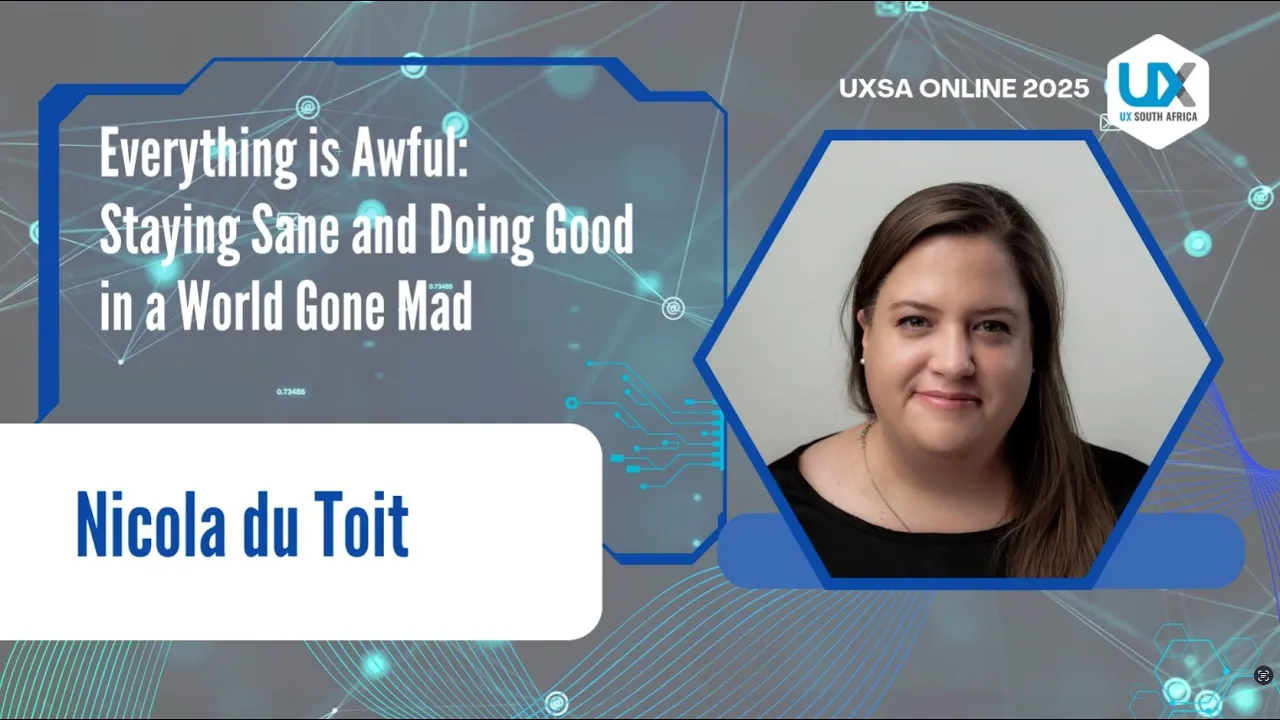
Everything is awful: staying sane and doing good in a world gone mad

Everything is awful: staying sane and doing good in a world gone mad

Nicola du Toit

Let’s be honest - the world seems pretty awful right now. Design has been swallowed up by the corporate machine, we’re regurgitating patterns and libraries so everything looks the same, and AI has finally arrived (disguised as bunnies on a trampoline) to take our jobs. Meanwhile we're all burned out, questioning our impact, seriously considering homesteading, and wondering how the hell we ended up designing for profit instead of people. This talk is a reality check and a pep talk rolled into one. We'll dig into how design has lost its way, why it's not entirely our fault, and most importantly, what we can actually do about it in our day-to-day work, in order to stay sane. No LinkedIn memes, no corporate jargon - just an honest conversation about getting back to designing things that don't suck for the humans who have to use them.

About
Reunion.ai logo

Delivering independent journalism, thought-provoking insights, and trustworthy reporting to keep you informed, inspired, and engaged with the world every day.

About

Reunion.ai logo

Delivering independent journalism, thought-provoking insights, and trustworthy reporting to keep you informed, inspired, and engaged with the world every day.

Talks from Day 1

Jan 29, 2026

/

Post by

Carien Moolman

Testing LLM-enhanced healthcare surveys with pregnant momsTesting LLM-enhanced healthcare surveys with pregnant moms

We designed 4 surveys typically sent to pregnant moms in MomConnect via WhatsApp and enhanced these with an LLM. In July of this year we did one-on-one in-person qualitative usability testing of these surveys as well as their statically designed counterparts with 17 pregnant moms in Khayelitsha, Cape Town. Each mom sat with a single facilitator and was asked to complete a survey twice: first the static version, and then the LLM-enhanced version, while facilitators observed and made notes. Right after completion, the moms were asked which one they preferred and why they preferred that one. We accounted for ordering effects by asking half of our moms to begin with the static version, and the other half to begin with the LLM-enhanced version. The surveys we tested were: - a demographic information survey - a 5-question decision-making ability assessment - a knowledge, attitudes, and behaviour assessment regarding pregnancy - a short survey typically sent after an antenatal clinic appointment We also tested a feature where moms could ask any pregnancy health-related questions, as freeform text, and get an answer from the LLM, where the LLM was limited to approved healthcare information provided by our content team. Our findings were fascinating and point to: (1) the risks of using LLM-enhancement and how this might affect the credibility of data gathered (2) the need to keep humans in the loop on both the design side and the data moderation side of these kinds of studies (3) the immense potential of LLM-enhancement in the provision of digital healthcare information and services

Jan 29, 2026

/

Post by

Sizwe Moabi

A Designer's Guide to Working with Legacy Systems

My talk is about how to work with legacy systems as a UX Designer. Often times we want to work on new software, or we want to redesign the existing products but we rarely ever think about the legacy systems. The old websites, the old government software, the old enterprise, corporate software that is outdated and is aging badly. We like the look and feel of new products but we cannot hope to improve existing systems if we don't sit with the tediousness of them. If we don't sit and face the uncomfortable software. As designers, we can improve existing systems if we strategically approach it from a caring point of view. With that being said, it's not an easy task. It's a difficult job with it's own nuances and somehow somewhere somebody has got to do it. My talk will be about understanding the context with which you find yourself working in as a designer, why legacy systems matter, the importance of knowledge transfer, how to approach redesigning outdated software, your relationship with developers when it comes to working on legacy products. How big your team size is. Why more capacity = more work being covered. Wins for your team, how to fight for your designs and best practices to employ. I will also be talking Usability and why taking shortcuts in the moment may seem good but it will cost your organisation the big wins in the long run. My talk is inspired by my current role as a designer working in the Tertiary Education space.

Jan 29, 2026

/

by

Aalia Coovadia

Testing LLM-enhanced healthcare surveys with pregnant momsTesting LLM-enhanced healthcare surveys with pregnant moms

We designed 4 surveys typically sent to pregnant moms in MomConnect via WhatsApp and enhanced these with an LLM. In July of this year we did one-on-one in-person qualitative usability testing of these surveys as well as their statically designed counterparts with 17 pregnant moms in Khayelitsha, Cape Town. Each mom sat with a single facilitator and was asked to complete a survey twice: first the static version, and then the LLM-enhanced version, while facilitators observed and made notes. Right after completion, the moms were asked which one they preferred and why they preferred that one. We accounted for ordering effects by asking half of our moms to begin with the static version, and the other half to begin with the LLM-enhanced version. The surveys we tested were: - a demographic information survey - a 5-question decision-making ability assessment - a knowledge, attitudes, and behaviour assessment regarding pregnancy - a short survey typically sent after an antenatal clinic appointment We also tested a feature where moms could ask any pregnancy health-related questions, as freeform text, and get an answer from the LLM, where the LLM was limited to approved healthcare information provided by our content team. Our findings were fascinating and point to: (1) the risks of using LLM-enhancement and how this might affect the credibility of data gathered (2) the need to keep humans in the loop on both the design side and the data moderation side of these kinds of studies (3) the immense potential of LLM-enhancement in the provision of digital healthcare information and services

Jan 29, 2026

/

by

Aalia Coovadia

A Designer's Guide to Working with Legacy Systems

My talk is about how to work with legacy systems as a UX Designer. Often times we want to work on new software, or we want to redesign the existing products but we rarely ever think about the legacy systems. The old websites, the old government software, the old enterprise, corporate software that is outdated and is aging badly. We like the look and feel of new products but we cannot hope to improve existing systems if we don't sit with the tediousness of them. If we don't sit and face the uncomfortable software. As designers, we can improve existing systems if we strategically approach it from a caring point of view. With that being said, it's not an easy task. It's a difficult job with it's own nuances and somehow somewhere somebody has got to do it. My talk will be about understanding the context with which you find yourself working in as a designer, why legacy systems matter, the importance of knowledge transfer, how to approach redesigning outdated software, your relationship with developers when it comes to working on legacy products. How big your team size is. Why more capacity = more work being covered. Wins for your team, how to fight for your designs and best practices to employ. I will also be talking Usability and why taking shortcuts in the moment may seem good but it will cost your organisation the big wins in the long run. My talk is inspired by my current role as a designer working in the Tertiary Education space.

Jan 29, 2026

/

Post by

Carien Moolman

Testing LLM-enhanced healthcare surveys with pregnant momsTesting LLM-enhanced healthcare surveys with pregnant moms

We designed 4 surveys typically sent to pregnant moms in MomConnect via WhatsApp and enhanced these with an LLM. In July of this year we did one-on-one in-person qualitative usability testing of these surveys as well as their statically designed counterparts with 17 pregnant moms in Khayelitsha, Cape Town. Each mom sat with a single facilitator and was asked to complete a survey twice: first the static version, and then the LLM-enhanced version, while facilitators observed and made notes. Right after completion, the moms were asked which one they preferred and why they preferred that one. We accounted for ordering effects by asking half of our moms to begin with the static version, and the other half to begin with the LLM-enhanced version. The surveys we tested were: - a demographic information survey - a 5-question decision-making ability assessment - a knowledge, attitudes, and behaviour assessment regarding pregnancy - a short survey typically sent after an antenatal clinic appointment We also tested a feature where moms could ask any pregnancy health-related questions, as freeform text, and get an answer from the LLM, where the LLM was limited to approved healthcare information provided by our content team. Our findings were fascinating and point to: (1) the risks of using LLM-enhancement and how this might affect the credibility of data gathered (2) the need to keep humans in the loop on both the design side and the data moderation side of these kinds of studies (3) the immense potential of LLM-enhancement in the provision of digital healthcare information and services

Jan 29, 2026

/

Post by

Sizwe Moabi

A Designer's Guide to Working with Legacy Systems

My talk is about how to work with legacy systems as a UX Designer. Often times we want to work on new software, or we want to redesign the existing products but we rarely ever think about the legacy systems. The old websites, the old government software, the old enterprise, corporate software that is outdated and is aging badly. We like the look and feel of new products but we cannot hope to improve existing systems if we don't sit with the tediousness of them. If we don't sit and face the uncomfortable software. As designers, we can improve existing systems if we strategically approach it from a caring point of view. With that being said, it's not an easy task. It's a difficult job with it's own nuances and somehow somewhere somebody has got to do it. My talk will be about understanding the context with which you find yourself working in as a designer, why legacy systems matter, the importance of knowledge transfer, how to approach redesigning outdated software, your relationship with developers when it comes to working on legacy products. How big your team size is. Why more capacity = more work being covered. Wins for your team, how to fight for your designs and best practices to employ. I will also be talking Usability and why taking shortcuts in the moment may seem good but it will cost your organisation the big wins in the long run. My talk is inspired by my current role as a designer working in the Tertiary Education space.

Talks from Day 2